
Five Things That Actually Work When You Sell Into Small Business
Why the AI-enabled solo firm is catalytic, why cash and time govern adoption more than budget does, and five things mid-market enterprises should build into any product or campaign aimed at the U.S. small business economy

The market is nearly the whole private sector
Selling into small business in the U.S. means selling into 36.2 million businesses, 99.9% of all businesses in the country, that together account for almost 46% of private sector employment, according to the SBA Office of Advocacy's 2025 Small Business Profile. Of that total, 29.8 million, or 82.3%, operate with no employees beyond the owner, per the SBA's FAQs About Small Business. The remaining 6.4 million firms employ paid staff, and even within that group, the range runs from a two-person shop to a firm with several hundred employees.
The gap between those two groups is not incremental. Nonemployer businesses averaged roughly $57,000 in gross receipts in 2022. The average small employer firm with 20+ employees took in >$2M million, some 30x more, calculated from the Census Bureau's Nonemployer Statistics and Statistics of U.S. Businesses. A go-to-market built for one is built for a fundamentally different customer than a go-to-market built for the other, and most enterprise sales and marketing motions are still built for neither.
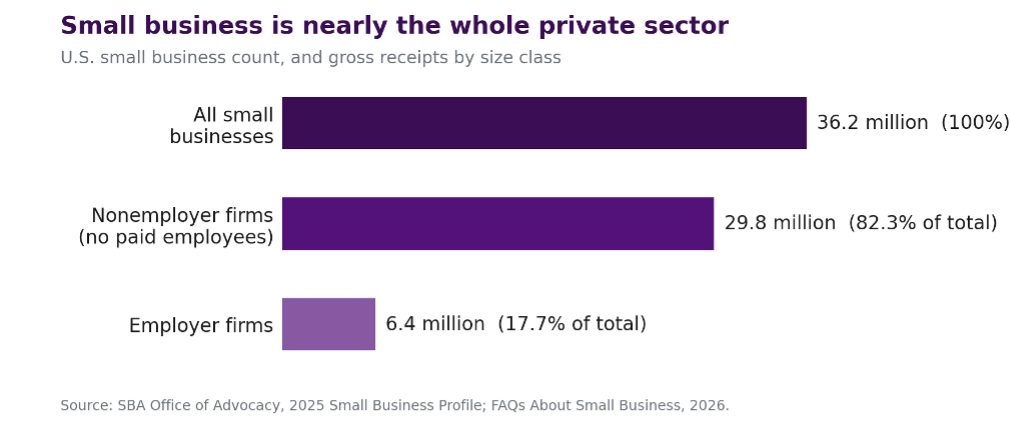
Figure 1. Nonemployer firms outnumber employer firms more than four to one, and the receipts gap between them runs to 44 times.
The catalyst
In June 2026, Americans filed 531,423 applications for new business tax IDs, according to the Census Bureau's Business Formation Statistics. Only 28% carried the characteristics the Census Bureau associates with a high likelihood of payroll, and just 35,695, or 6.7%, listed a planned first wage date.
What has changed is not ambition but the fundamentals. Marketing, bookkeeping, and documented procedures once required hiring someone or retaining a firm. AI agents now produce them. The first employee used to be a purchase of capability. It is becoming a purchase of capacity, and that is a different and far later decision, which pushes more of the relationship into the stages before a first hire ever happens.
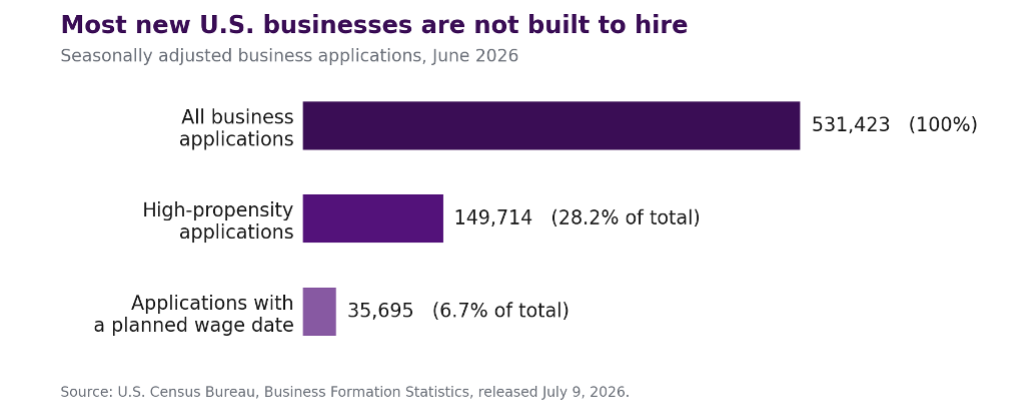
Figure 2. Fewer than one in fourteen new applications indicates any intent to pay wages.
What actually governs adoption: cash and time, not features
The binding constraint on whether a small business adopts anything is rarely the owner's desire for the capability. It is whether the business has the cash and the hours to get there. The median small business holds a cash buffer of 27 days, enough to cover typical outflows for less than a month if money stopped coming in; a quarter of small businesses hold 13 days or fewer, according to the JPMorgan Chase Institute's Cash Flows, Balances, and Buffer Days research. There is usually no discretionary line item for a six-week onboarding, a seat-based annual contract, or a feature that requires training, because in 82.3% of these businesses there is no one else to train. Every enterprise that has actually taken hold in this market has built around that constraint rather than around the feature list. The five things below are what that looks like in practice.
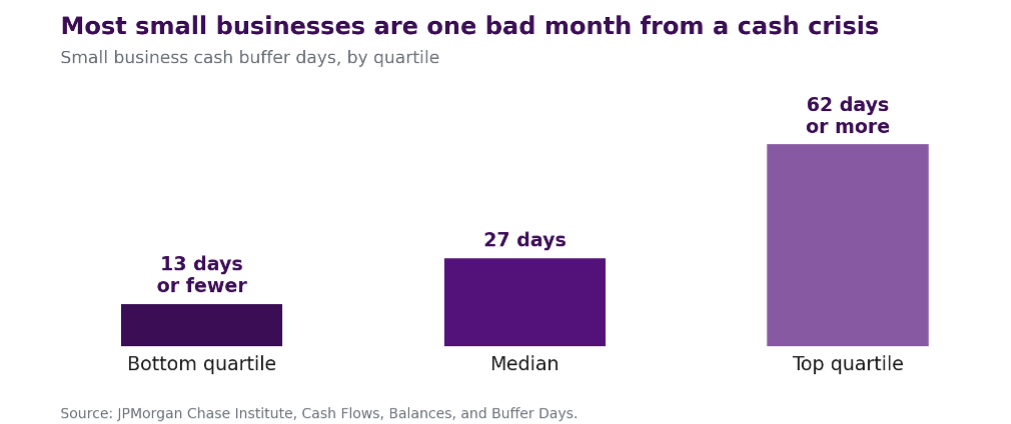
Figure 3. A quarter of small businesses could not absorb two missed payments in a row.
The five things
The products and campaigns that have actually taken hold in the small-business economy share a few traits, and none of them depend on offering more features than the competition.
1. Solve one specific, named problem. Square grew by fixing one specific problem: a business that couldn't get approved for a merchant account couldn't accept cards at all. The free reader and pay-per-swipe pricing solved exactly that, and everything else Square built came after.
2. Let the owner start using it immediately, with no sales call. This is why so much small business software is sold on a free trial rather than a demo and a contract. A trial isn't just a discount on the first month, it's a way of getting a business dependent on the product before ever asking for payment. Once a business starts running part of its actual work through a tool, invoices, scheduling, customer records, the cost of switching away starts to outweigh the cost of just paying for it. The more a business adopts a tool into how it actually operates, the harder that tool becomes to leave, and that dependency is what a trial period is quietly built to produce.
3. Charge in a way that matches how the money actually comes in. Square doesn't charge a monthly fee. It takes a small percentage of each sale, so the cost only shows up once the revenue does. That fits a business with uneven, unpredictable cash flow better than an annual contract with a large bill up front.
4. Build the network that recommends you, and the resources that help the business grow. QuickBooks' growth runs largely through the accountants and bookkeepers who recommend it to their clients, which is a distribution advantage. The more durable version of this is providing the actual resources, bookkeeping support, financing, advisory access, that help a small business operationalize and grow its revenue. A vendor that helps a customer grow bigger earns a bigger customer later, not just a longer subscription.
5. Keep learning from how the product actually gets used. QuickBooks' parent company, Intuit, has sent researchers into customers' workplaces to observe usage since founder Scott Cook started the company's “Follow Me Home” program in 1989, a practice Fast Company has documented, because owners often can't recall afterward how they actually used a product. What a solo founder needs in year one is rarely what the same founder needs after their first hire. The vendors who stay useful are the ones tracking that shift, not shipping the same product to everyone regardless of stage.
That last point is worth making concrete, because the shift from stage to stage is where most vendors lose the thread. Of every 1,000 businesses that file to form, all 1,000 start out the same way: a solo founder with no staff. Most stay there indefinitely, which is the stall point in the chart below, a business that has hit the ceiling of what one person can produce but has not yet added headcount. Only 77 of those 1,000 ever make a first hire, and only about 4 grow past 20 employees. Each of those four positions is effectively a different customer with a different problem: a solo founder needs friction removed so they can start at all, a business stalled at the ceiling needs capacity or differentiation to move past one person's output, a business making its first hires needs payroll, compliance, and management tooling it has never needed before, and a scaled business needs the same range of infrastructure a much larger company runs. A vendor selling the same product and pitch to all four is really selling to only one of them well.
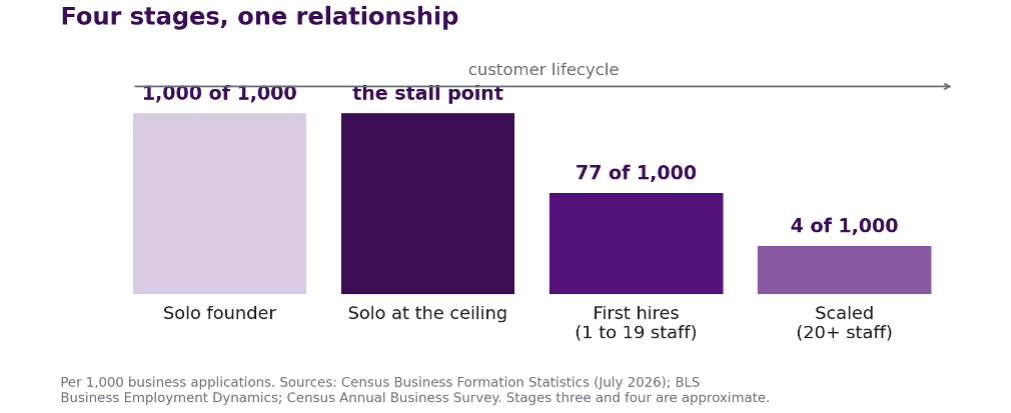
Figure 4. Only 77 of every 1,000 applications become employer firms within two years, and roughly 4 reach 20 staff.
These five things matter more or less depending on where a business sits in that lifecycle. Removing friction and keeping things simple matter most at the start, when most businesses are solo and nonemployer. Building the support network and staying on top of the data matter most from the stall point onward, once a vendor needs to notice a change in the customer before the customer announces it.
What to measure
Net revenue retention among customers under five employees, the share of entry-tier customers still active at 24 months, and the share who cross into a first hire. Corporate profits reached a record 13.9 percent of gross domestic income in the first quarter of 2026, according to the Federal Reserve Bank of Richmond's analysis of Commerce Department data. The vendors compounding that will be the ones who remove friction, keep the experience simple, price to match the customer's cash flow, build the network, and use the data to know which stage a customer is actually in before the customer does.
About Beony
Beony is at the symbiosis of this relationship. We advise small and growth-stage businesses on strategies to navigate these stages, and we advise mid-market and enterprise organizations seeking to sell into the small-business economy. That connection is what lets us translate what a small business actually needs into what a larger organization should build, price, and say to reach it. If that's your go-to-market challenge, let’s connect!
