
Why Strategy Matters More Than Ever in the Age of AI
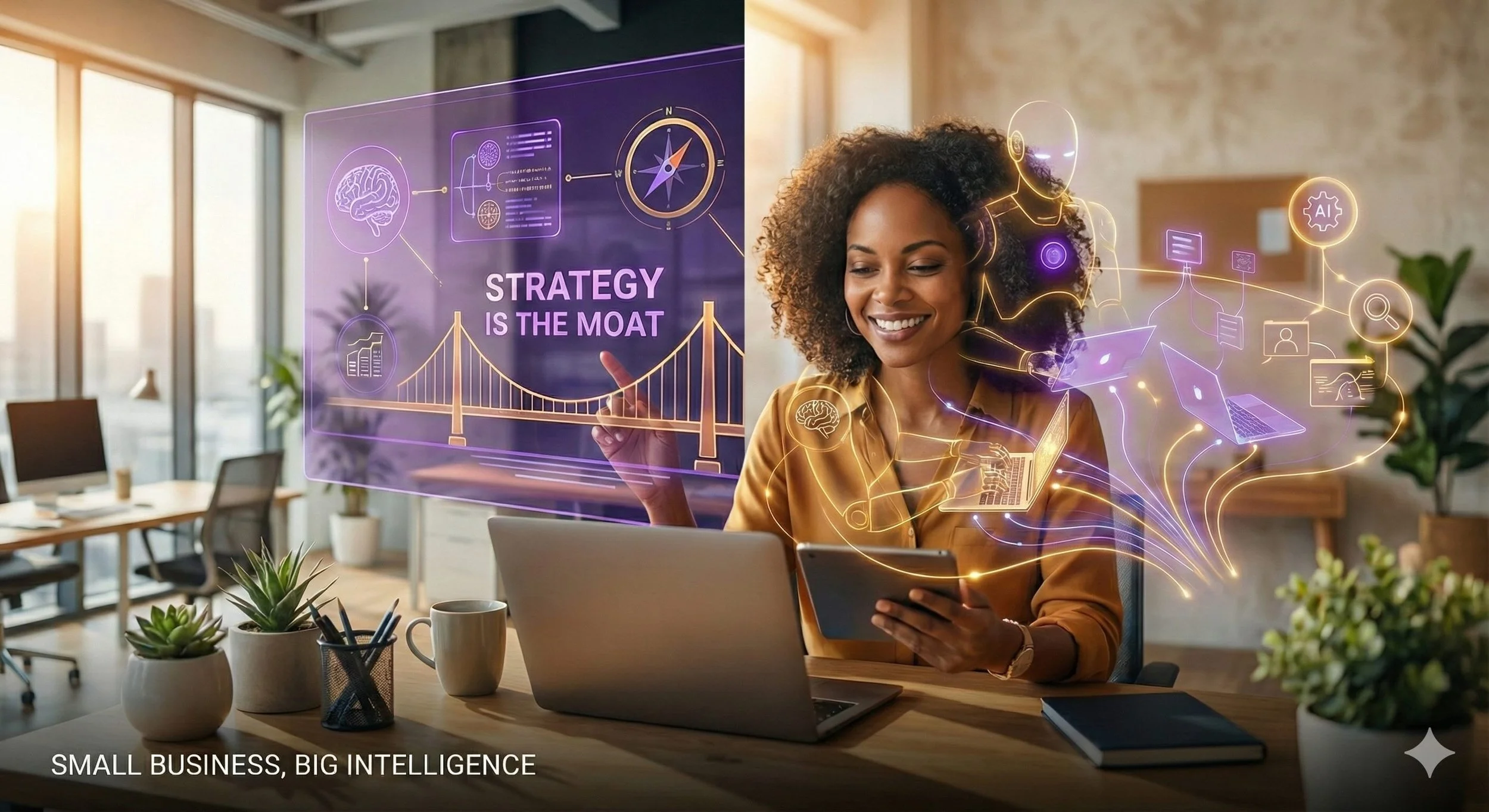
AI is changing the way small businesses operate and compete for growth.
For decades, the equation for business growth was rigid: if you wanted to scale, you needed capital. You needed to hire more people, rent more space, and buy more equipment. Scale was a luxury reserved for the well-funded.
Today, that equation has evolved. We are witnessing a shift where scale no longer requires massive capital; it requires massive strategy.
Consider the speed of this transformation. It took the internet nearly a decade to reach the level of adoption that artificial intelligence achieved in just two years. This isn't just another tech trend; it is a fundamental rewiring of the economy. Today, 99% of small businesses utilize at least one technology platform to run their operations. The digital divide is no longer about access to technology—everyone has the tools. The new divide is between those who use technology to add to the noise, and those who use it to cut through it.
The "Content Flood" and the Crisis of Conversion
As AI adoption accelerates, we face a new paradox. Intelligence is now "on tap," allowing small businesses to hire "digital labor" on demand. In fact, 82% of leaders expect to use AI agents to expand their workforce capacity within the next 12 to 18 months.
But this accessibility comes with a side effect: a flooded marketplace. When blog posts can be written in seconds and social media calendars filled in minutes, awareness becomes cheap. The barrier to creating content has vanished, meaning your customers are about to be inundated with more marketing messages than ever before.
For the modern small business, the challenge is no longer getting noticed; it is getting trusted. The battleground has shifted from awareness to consideration and conversion. In a world of infinite content, the businesses that win will not be the ones shouting the loudest, but the ones that understand their customers the deepest.
Moving Beyond "Tourism": Deepening Understanding
Despite the clear opportunity, many small businesses are falling into a dangerous trap: treating AI like a tourist. They visit ChatGPT, ask it to write a generic blog post, and call it a day.
Research indicates a staggering gap between experimentation and integration. While 92% of companies plan to increase their AI investment, only 1% of leaders believe their AI investments have reached full maturity. The "tourists" use AI to generate volume. The "strategists" use AI to generate insight.
To bridge the gap from awareness to conversion, small businesses must use AI to radically expand their horizon on what is possible. This means using AI not just to speak at customers, but to understand them and expand the possibilities of solutions to further serve those customers. It means analyzing customer sentiment, predicting market shifts, and identifying unmet needs with the precision previously accessible only to Fortune 500 companies.
The data confirms that this strategic depth pays off. Companies identified as AI leaders are seeing 1.5 times faster revenue growth and 1.6 times higher shareholder returns than their peers.
The Financial Imperative: Why You Can’t Afford to Wait
For small businesses operating in a landscape defined by inflation and supply chain volatility, AI is not just a productivity hack; it is a growth engine.
When used strategically to deepen market understanding, AI becomes a primary value creator. Among small businesses that have adopted AI, 85% report increased sales, and 84% report increased profits.
Even more telling is the impact on employment. Contrary to the fear that automation leads to downsizing, 82% of small businesses using AI actually increased their workforce over the past year. This proves a vital economic truth: AI fuels expansion. When you use AI to remove the drudgery of low-value tasks, you free up your human talent to focus on the high-value work of relationship building and closing sales.
The Strategic Shift: Empowering Humans to Lead Agents
To achieve this level of sophistication, business owners must focus on empowering and upskilling their human teams. You cannot build an "AI-first" company without being "people-first."
Success requires a mindset shift from viewing AI as a tool for commands to viewing it as a collaborator. Leaders are already making this shift, with 54% of surveyed leaders viewing AI as a "thought partner" rather than just a utility.
This is the birth of the Frontier Firm, organizations that have successfully blended human judgment with machine speed. In these firms, humans act as the architects of strategy, directing teams of AI agents to execute complex workflows. By upskilling your human team to manage these agents effectively, you create an organization that is 2x as likely to report it is thriving compared to the global average.
Conclusion: Make Strategy Your Sustainable Advantage
The barrier to entry for business has never been lower, but the barrier to success is rising. Technology is no longer the bottleneck. The tools are here: they are affordable and powerful.
The bottleneck is leadership.
The small businesses that win in the next decade will not be the ones producing the most marketing campaigns. They will be the ones using AI to listen, to understand, and to serve their customers more deeply than their competitors. They will be the ones who invest in their people to lead their AI agents, turning their business into a Frontier Firm.
You must stop waiting for the "perfect" time to adopt AI. The technology is ready for deployment. The question is: is your strategy? It is time to stop touring the future and start building it.
